
This post was last updated on July 15th, 2026 at 12:39 pm
Many people think that “getting in shape” involves a gym, or doing exercises that require them to carve out time from their busy schedule. But what if there’s an easier way to become more physically active? What if you could become physically active as you go about your everyday routine? You might feel less pressure to exercise if you’re finding ways to be more physically active outside the gym.
Our modern culture has been engineered to keep us as sedentary as possible. Years ago, nobody exercised in the traditional sense because their everyday life was filled with exercise: Chores and transportation all required physical exertion. But that’s not true anymore. We’re conditioned to seek out the most convenient path and to separate exercise from our daily routines. But if you allow yourself to rethink this paradigm, you can start to increase your physical activity levels without upending your routines.
There is actually a word to describe the type of physical activity that I’m talking about here. It’s called (brace yourself, this is a mouthful) non-exercise activity thermogenesis, or NEAT. NEAT describes all the physical activity you do that’s not sport related. But don’t let the “non-exercise” part of NEAT fool you. These activities can be a strenuous as you want them to be.
The true benefit of my approach to exercise is that it combats the sedentary lifestyle. All that’s required is an ability to identify and act on opportunities to move more as you go about your daily routine.
The science behind physical activity that is NOT exercise
I don’t make any claims in terms of weight loss, but it is interesting to note that a 1999 study on overeating found those people who overate but maintained higher levels of physical activity were able to maintain a healthy weight, unlike those who overate but weren’t as physically active. The study examined the effect of NEAT. Those who didn’t gain weight burned more calories through high NEAT levels. Speaking from personal experience, I’ll note I still have the same waistline now as I did in high school, and I don’t diet or take pills or anything.
Because everyone’s daily, weekly, and monthly routines are different, it’s difficult to tell someone exactly how they should increase their physical activity levels. It does take some practice and focus to become more aware of your environment and to identify the sedentary pitfalls within your daily routine. Here are five examples of how you might increase your physical activity levels, without having to go to the gym or hop on exercise equipment:
01 Biking or walking to work
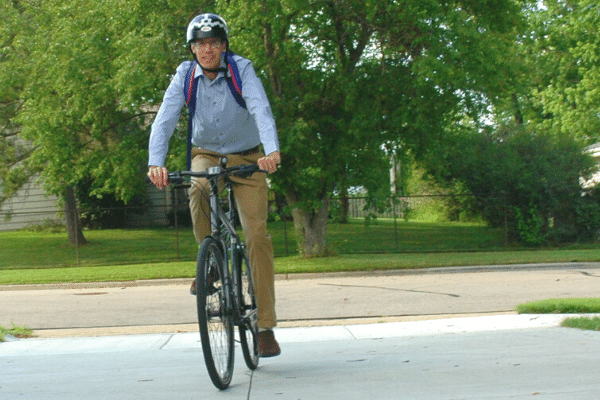
Not just work. Can you also bike or walk to the store, library, or just about any place. Make a list of all your weekly and daily destinations and ask yourself whether you can bike or walk to one of them regularly—look for what I call your frugalmatic sweet spot. Even if you only bike 15 miles a week, that adds up to 780 miles a year. By using a bike to get to where you need to go, you’ll “force” yourself to get regular exercise. It’s even possible to bike in the winter with a few additional accessories, such as metal-studded bike tires.
02 The yard work(out)
If you have a yard, think of it as a cross-training course. Mowing and raking leaves are two great ways to work up a sweat. Swapping out a power mower with a push reel mower can intensify the job. Look around your yard and home, and there’s unlimited exercise opportunities: washing windows, trimming hedges, spreading mulch, weeding, caulking, and painting. I once burned nearly 14,000 calories by painting our house’s exterior. All these tasks can turn yard work into workouts.
03 Cleaning the house
I’m not a big fan of cleaning, and I probably have a lot of company on this one, but cleaning affords a lot of opportunity for exercise. Consumer culture promotes things like robotic vacuum cleaners to reduce your workload. But in trading the classic vacuum for a robot, you’re giving up some physical activity.
04 Playing with the kids
It doesn’t matter how silly children’s games might seem, if they involve physical activity, it’s good to indulge in them. Parents with little ones scampering around the house don’t need trainers because their kids are the trainers. If you follow their lead, you can end up feeling like you just ran a race. Playing with your kids is frugalmatic: You get exercise, plus a bonding experience. And if you’re frugal (which of course you are), playtime won’t cost a cent.
05 Take the longer route
Many of us have day jobs that involve a lot of sitting. But even at the most sedentary jobs, you can often boost your physical activity levels. For example, when you have to use the restroom at work, consider walking to one on another floor or one farther down the hallway. When you arrive at work, consider parking at the back of the lot to increase your walking distance.
Sometimes walking isn’t intended to bring you from point A to point B. I call this type of exercise an offset. Here’s one of my favorite offsets: If I’m involved in a long telephone conversation, I like to pace around a room, even taking the conversation outside. The person on the other line doesn’t know it, but I’m getting a small workout as we chat. Any physical activity without a practical purpose, aka exercise, falls into the offset category.
No more worries about whether you’re active enough
Being frugalmatic means that you’re not just exercising at certain times of the day. Rather, you’re stealthily sprinkling physical activity into your daily routine, to the point that other people might not notice just how physically active you’ve become. To be clear, I have nothing against traditional exercise. But let’s face it: Not everybody enjoys working out for the sake of working out.
With the frugalmatic approach, you’re not caught up in how fast you’re running or what type of exercise equipment you use. You’ve developed what I call the physically active mindset. With this mindset, you’ve developed a routine that automatically builds physical activity into your day, so you don’t have to stress about whether you’re being active enough. It just happens naturally. No worries about going to the gym because you’ve essentially turned your environment into a gym.