
This post was last updated on March 13th, 2026 at 04:48 pm
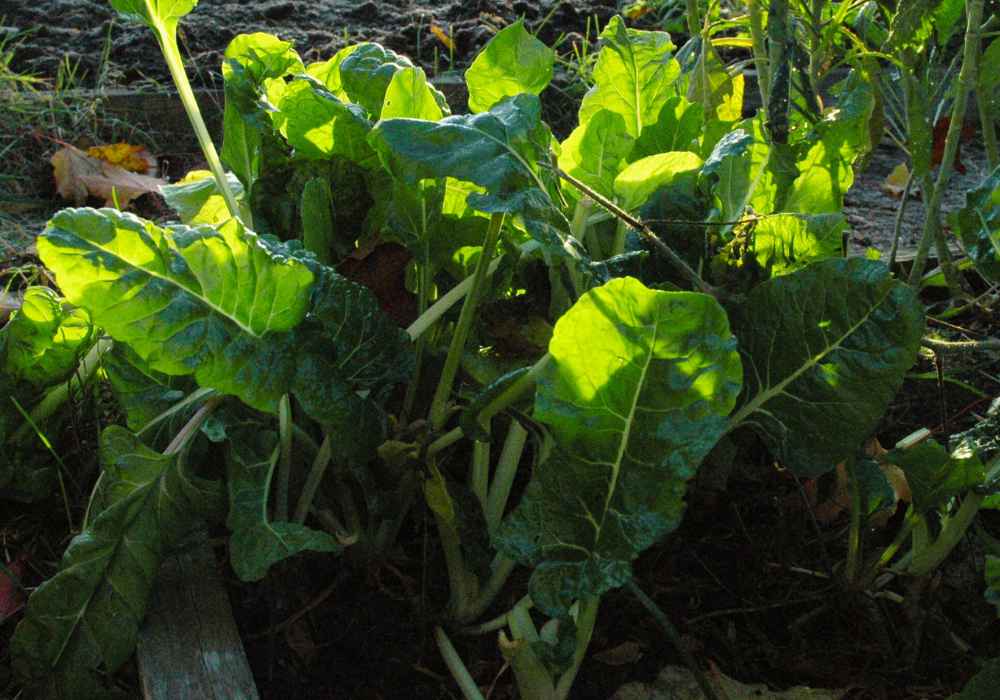
The Swiss chard is now covered in a foot of snow, but amazingly it continued to produce until just a few days ago. It nearly made it to December! For the past several weeks, I’ve been harvesting the chard to use in place of lettuce in our family’s turkey sandwiches. For that reason, our family almost completely stopped buying lettuce. Swiss chard checks all the boxes: It’s plentiful, hardy, and tasty. It’s the GOAT of our garden.
My appreciation for this leafy green has evolved over time. I didn’t always put chard in sandwiches. For whatever reason, I thought chard needed to be cooked, that it was too tough to enjoy raw. I’m not sure exactly when or why (probably because we ran out of lettuce) I started adding it to sandwiches. But once I started a couple years ago, I didn’t stop. Chard is more tender than I had imagined. It’s not as tender as spinach, but nearly so.
Why chard beats spinach
I love spinach, and I would prefer it except that spinach’s growing season is too short. The problem is, spinach bolts too easily, meaning the summer heat causes the plant to go to seed. Once that happens, the leaves turn bitter. There are some heat resistant varieties, but I still find them unable to withstand an extended heat wave.
On the other hand, I can’t remember the last time our chard bolted. Swiss chard perseveres in the heat and thrives in cooler weather. It seems to survive down to around 20 degrees.
Spinach enthusiasts might point out that you can plant a second crop of spinach and harvest it during the fall months. But there’s a risk. Whenever you plant seeds, there’s a chance they won’t germinate (don’t even get me started on my difficulties growing carrots). Plus, there’s that multi-week gap between the time you plant and the moment you can start harvesting. With chard, you plant it in May and that’s it. Then you harvest throughout the summer and well into fall.
Why chard also beats kale
In our garden, chard’s other main competitor is kale. I’d say they’re equally hardy, as you can also harvest kale late into the fall. When it snowed here in mid-November (not this latest blast with a foot of the white stuff), both our chard and kale survived.
However, I find kale to be less versatile because it’s both less tender and more bitter. Finely chopped kale works well enough in salads. But when it comes to sandwiches, kale takes too much effort to chew. And it’s bitter.
In terms of the stems, chard outshines kale. Chard stems are tender and almost sweet, making them ideal for soups and casseroles. Kale stems are tougher than the leaves, which is why I toss them into our compost. I like that I can use the whole chard plant, and you can’t say that for kale and a lot of other garden veggies.
Read: How to create a more active daily routine
How Swiss chard compares nutritionally
You can’t go wrong eating kale, spinach, and chard. They are all packed with nutrients, with some having higher levels of certain vitamins and minerals than others. Chard is known for its high levels of vitamin K, vitamin A, and magnesium. It’s also a good source of fiber and contains cancer-fighting antioxidants. I’m not a nutritionist, so I’ll let you, the reader, take a deeper dive into the issue.
Chard needs only a small amount of space
Chard is one of the main reasons our family doesn’t spend much money on lettuce. It’s a continual source of fresh leafy greens. It’s so dependable, in fact, that we don’t bother storing any in our refrigerator. Whenever I need some, I step into our backyard garden (often wearing a robe and slippers as the sun rises) and snip a few stalks.
The cool thing is that you don’t need a lot of space to grow it! Our crop is contained within a 2-by-3-feet area, and the plants constantly generate new leaves.
Why chard is the GOAT of our garden
We live in Wisconsin, where the growing season is on the shorter side. That first frost usually hits around late October, which wipes out most of our veggies. It’s during these fall months that chard’s star shines.
Chard’s status as the GOAT of our garden didn’t emerge instantly. Other vegetables, namely tomatoes, tend to hog the spotlight and often receive more attention than the humble chard. The truth is, it’s taken several years for me to fully recognize chard’s value.
You really start appreciating chard after it becomes the only thing you’re still harvesting, week after week. I mean, our chard has been producing for us for nearly six months—half the year! That’s a big reason why chard has become the GOAT of our garden. If I only had room to plant a single vegetable, it would have to be Swiss chard. It’s arguably the most versatile veggie and has the longest growing season. What can beat that?