
This post was last updated on September 7th, 2026 at 09:09 am
How can we limit the amount of time we spend on our smartphones? That question was the heart of my recent conversation with Stephanie Seferian on her podcast, Sustainable Minimalists. I’ve never claimed to be blessed with a huge amount of willpower, I explained. I cut back on screen time by simply eliminating access. I don’t have a smartphone.
She compared smartphones to junk food. It’s a good comparison. “If I buy four gallons of ice cream, I can tell myself I’m going to ration this out over the whole year,” I said. “And everyone here knows that’s not going to happen. So the real solution is just not to get the ice cream.”
When it comes to smartphones, the question of access is often overlooked. Many people want to find a way to moderate their use while still having the phone. This works for some people. A notable example is Cal Newport. He wrote a book called “Digital Minimalism” and encouraged people to set aside their phones and go through a detoxification process. But he didn’t call for them to give them up completely. In fact, Newport himself uses a smartphone.
Like I told Stephanie: If you are the kind of person who can moderate their smartphone use, kudos to you. I’m probably not one of those people. Yet, I spend much less time I’m on my phone than most people do theirs. That’s not bragging. Again, it’s not willpower. It’s just that I use a dumbpone, and there’s just not much you can do on a dumphone except call and text and maybe check the weather.
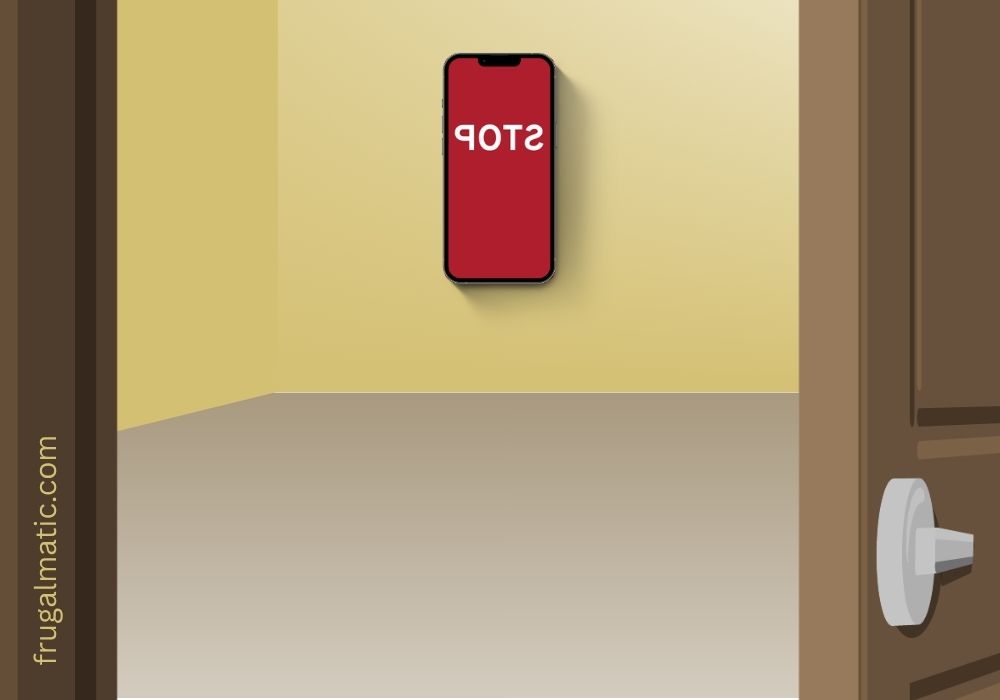
To block access is to create distance
This access denial strategy works not just for phones but can be used to limit consumption of just about anything. It’s overlooked because, in our culture, consumption is a way of life, generally not something to be questioned. It is not a choice. It is the premise. To not consume is often viewed as abnormal. Under this framework, excessive consumption, if it becomes a problem, isn’t met with less consumption but with a change in what we consume.
Indeed, there are many products designed to help smartphone users cut back, such as the Brick. This gadget looks like a little square, and it pairs with your phone. The Brick acts like a lock of sorts. It blocks you from accessing distracting apps, as long as you separate yourself from the Brick. You can only access these distracting apps once you touch the Brick to your phone. It works for some people, but I would argue this gadget blocks you in the same way that a lid blocks you from opening a carton of ice cream. The Brick creates a little separation, but it’s not really denying access (unless you ask someone to hide the Brick and not tell you where it is).
When we talk about denying access, we’re talking about placing as much distance between yourself and the thing you might hold a little too close to your heart. I will use baseball as an example. Baseball is very big in our house. We love the Brewers, and I listen to most games during the year Keyword: listen. I don’t watch them, for the most part. I’m smart enough to know that if I had access to the Brewers channel, I’d be plopped on our couch. A blob for multiple hours, multiple days a week.
Each year the baseball gods tempt me, but each year I avoid buying the channel. I opt for the radio, instead. It’s the easiest way for me to not become a blob on the couch, and save a little money.
Promote access to consume more of the good stuff
Access cuts both ways, keep in mind. You can work to deny yourself access to the bad stuff and also promote access to the good stuff.
When it comes to food, gardening gives you great access to all sorts of healthy eating options. One of my favorites is Swiss chard. There’s no way we’d eat as much chard as we do if not for our garden. I saute chard, steam chard, add it to sauces, and even use it as a substitute for lettuce. I also discovered that chopped-up, frozen stems in a Ziploc bag make for a great ice pack to put on bumps and sore muscles.
Here’s another garden example: This time of year, we’re getting a lot of green beans from the garden. I’ve been putting a bowl of them on the kitchen table and, sure enough, everyone’s snacking on them, including myself. Not because we’re health nuts but because the beans are sitting there, and we keep walking by the table. If I had put out a bowl of Skittles, we’d be munching on those for the same reason we’re munching on the beans.
Funny enough, Stephanie Seferian responded to my hypothetical about bringing home four gallons of ice cream with a real-world example. She shared a story about her husband getting a great deal on 18 pints of ice cream, Ben & Jerry’s. “We have a deep freezer, and we thought to ourselves, ‘We have ice cream for the next year,'” she told me. “You want to know, Andrew, how long that ice cream lasted? It was about 3 weeks.”
Yeah, and that would be true for just about all of us.
Focus on access because willpower is a poor performer
Of course, we can’t deny ourselves pleasure all the time. That’s not what I’m advocating here. I eat my fair share of ice cream, after all. But I respect access and its power. At the same time, I acknowledge that willpower is a relatively poor performer when it comes to enforcing moderation. I’m not saying willpower is irrelevant, but relying on willpower alone is often a recipe for disappointment. That’s when denying yourself access can help you moderate consumption.