

This post was last updated on August 12th, 2026 at 08:15 am
My Mom says she encouraged me as a child to learn how to juggle, but I never showed an interest. I suspect a lack of patience kept me from embracing this skill. I remain short on patience today, but my attitude toward juggling changed after a recent chat with an eye doctor. His top recommendation for developing hand-eye coordination was to learn how to juggle. His advice was actually meant for our kids, but I took it as a personal challenge.
I quickly discovered that juggling isn’t nearly as difficult as I previously believed. To be sure, it involves a lot of failure, something children often cannot tolerate. But as an adult, the prospect of failure unfazed me (because I’ve experienced plenty). Rather than feel discouraged as I dropped ball after ball after ball, I embraced the process. Juggling, I realized, fit perfectly into my lifestyle. And I thought it would be a good fit for some of my Frugalmatic readers.
Juggling as an ideal offset
You see, juggling is an excellent offset. For those unfamiliar, I refer to exercise as offsets. Offsets are designed to offset the time we spend being sedentary, such as while staring at screens.
Offsets are less preferable than frugalmatic activities, such as biking to work, which allow us to be physically active while accomplishing a specific task. However, in a digital-oriented world, it’s difficult to lead a physically active lifestyle without needing to exercise in some amount. Thus, I’m always on the lookout for offsets which fit easily into one’s daily routine and don’t require going to a gym or buying expensive equipment.
A nice break from the pursuit of ‘steps’
One thing I like about juggling is it doesn’t involve steps. We’ve become a very step-conscious society. With their devices, people keep track of the number of steps they amass during a day. I regularly hear people reference activities that will give them steps. Now, don’t get me wrong. Studies have found a correlation between mortality rates and daily step amounts. The more steps you get, the longer you tend to live. But this hyper-focus on steps seems to ignore an important point: We also have hands and arms.
Enter juggling, which is almost exclusively a hands-and-arms thing. One problem with many offsets is the large physical space required to perform them, such as with walking (unless you’re on a treadmill). Another problem is many offsets require being outside, where the weather becomes a factor.
To be clear, I am not a personal trainer or a doctor, nor am I interested in becoming one. But I will say this about juggling: It is easy on the body. Aside from bending down to pick up dropped balls, the movements require mainly standing and holding out your arms while tossing three soft little balls into the air. Unless you’re trying to catch flaming sticks or knives, the injury risk is small.
Plus, you can’t beat the price
One of the attractive aspects of juggling is it is frugal. When I started, I tried tennis balls but quickly learned they’re no good. They bounce everywhere when dropped.
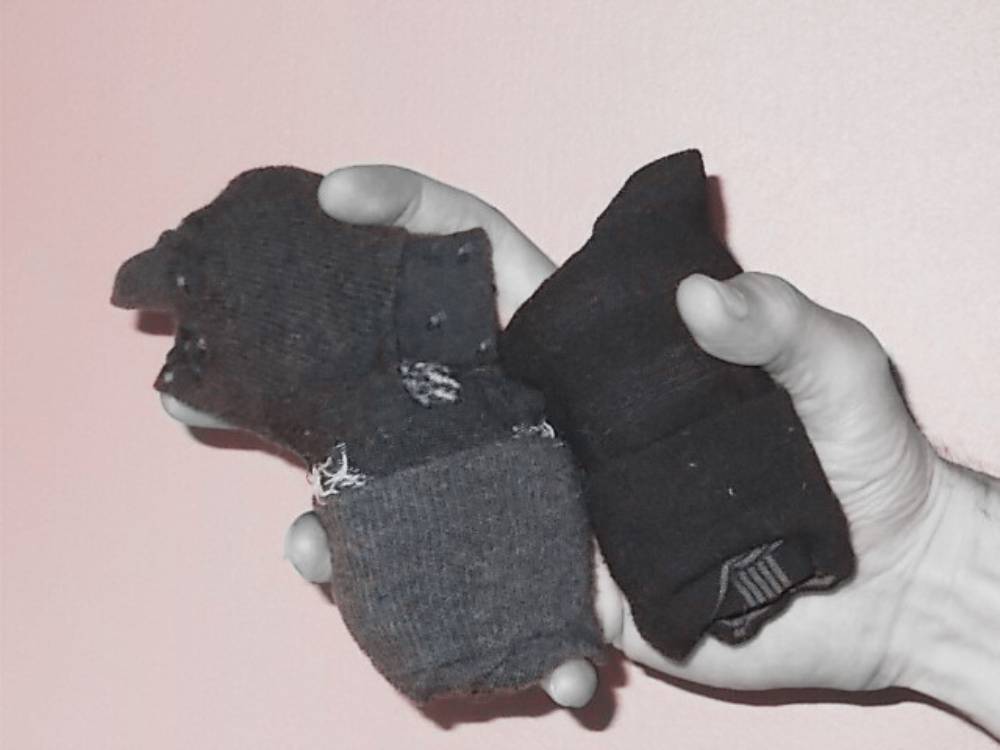
Then I switched to socks. I rolled pairs together to create juggling balls. I got that idea from YouTube, which is, by the way, the best place to learn how to juggle. There are lots of videos available on juggling. It’s just a matter of finding a video that suits your skill level and personality. I found a YouTube video by Taylor Glenn the most helpful.
I eventually purchased Duncan-brand official juggling balls. If you want to pursue juggling, I recommend using balls designed for it. These Duncan balls fit nicely in your palms and are easier to grip than hard, round balls. The beauty of juggling is you can do it almost anywhere. I’ve practiced a bunch in the kitchen, while watching TV in the living room, and outside on the lawn. There aren’t a lot of barriers, except perhaps low ceilings.
Juggling as a workout or something more casual
In terms of juggling being a “workout,” it depends how long you juggle and at what intensity. I’ve worked up a sweat after some sessions, though I typically juggle for only five minutes or so at a time. Juggling can be a hardcore, heart-pounding experience. For me, it’s mostly a casual activity, something I’ll do after walking into a room.
If you haven’t tried juggling, what could possibly be stopping you? If you tried it a long time ago but gave up, you’re like many others. All I can say is: Try it again. Just know that it takes patience. You will drop a lot of balls while learning, and you won’t start off with three balls. You’ll want to master one ball first and then progress to two. After two comes the third, naturally. I haven’t tried four, but it’s one of my future goals. For now I’m content with three. That’s enough for me.
Great article, Andrew! I may take you up on the hobby of juggling.
Juggling is a great metaphor for life…throwing things up, trying to catch what we’ve tossed out, dropping the ball, and continuing with a fun free flowing display of color.